| Сегодня 15 марта, воскресенье |
      |
  
|

  
Какой рейтинг вас больше интересует?
|
Главная /
Каталог блоговCтраница блогера КвантоФорум :: Recent Posts/Записи в блоге |



 |
КвантоФорум :: Recent Posts
Голосов: 1 Адрес блога: http://quantoforum.ru Добавлен: 2013-05-02 14:40:55 |
Теория сжатия Вселенной версия #8 15 - 16 годов
2017-02-01 18:23:43 (читать в оригинале)Vladimirovich wrote:
wpiter wrote:

Да, даже мне интересно было бы взглянуть на эти расчеты.Я думаю, наш форум достоин того, чтобы они были обнародованы именно здесь. Уверен, что никто из нас не использует их в корыстных целях и не посягнет на авторские права ув. впитера.
я достаточно точно рассчитываю параметры Вселенной...
Отрицая всю современную математику? Упорными медитациями и наблюдениями потолка? Теория сжатия Вселенной версия #8 15 - 16 годов
2017-02-01 18:20:08 (читать в оригинале)An Accelerating Universe, or Light Slowing Down?
February 2, 1999
Astronomers have recently announced that the universe appears to be expanding at an accelerating rate. This is inferred because distant supernovae are unexpectedly dim. This is interpreted as implying that the expansion of the universe is faster now than it was before. This expansion is in turn explained by some mysterious repulsive force that is pushing the universe apart.
Another possible explanation is that the speed of light is slowing down. This explanation would avoid the need for such a repulsive force. But in order to understand this explanation, we need to understand more about the red shift.
Cosmologists believe that the red shift of light is caused by the expansion of space as light travels from distant objects. This expansion of space causes the light waves to become farther apart, and thus longer, and red shifted. The more time light has been traveling, the more time there has been for space to expand, and the greater the red shift. Thus more distant objects have a larger red shift.
Originally, it was believed that the red shift was proportional to distance (Hubble's law). However, the accelerating expansion of the universe was inferred because distant supernovae are fainter than expected based on their red shift. This means that they are farther away than one would expect based on the linear increase of red shift with distance. So if we let r(d) be the red shift of an object that is distance d away from us, then r(d) increases rapidly for objects near us, but then more slowly for objects farther away. Thus these objects are fainter than they would be if the red shift function r(d) were a constant multiple of d.
This is interpreted as evidence that the universe was expanding more slowly in the past, so that the red shift of distant objects is less than one would expect. When the light from distant objects began its journey, the universe, and therefore space, was expanding more slowly. Thus there was a smaller contribution to the red shift than for light that traveled more recently. Nearer objects are less subject to this slowdown, because the universe was expanding faster when light left them. Thus their red shift is comparatively larger, in proportion to their distance from us.
Suppose that a distant object is at distance d = d1 + d2 from us. Its red shift is then r1(d1) + r2(d2), where r1(d1) is the contribution to its redshift during the initial transit of light through a distance of d1, and r2(d2) is the contribution to the redshift from the final transit through a distance of d2. We can assume that r1(d1) = c1 * d1 and r2(d2) = c2 * d2, where c1 < c2 because the universe was expanding more slowly in the past. For an object at distance d2 from us, the red shift will be c2 * d2. Hubble's law would give the red shift for the distant object as c2 * (d1 + d2), which is c2 * d1 + c2 * d2. Since c1 < c2, this is larger than the observed red shift for the distant object. Thus we have that distant objects have a smaller red shift than one would expect, based on Hubble's law. In this way, this observation can be explained by an accelerating expansion of the universe.
This effect can also be explained by a slowdown in the speed of light. If light were traveling faster originally, then a slowdown would make distant objects appear fainter. The reason these supernovae would appear fainter is that light was traveling faster when it left them. This would make these objects appear farther away than they really are. This would also mean that the light spent less time in transit, so that there would be less time for space to expand, and thus the red shift would be reduced. Since light was traveling faster through the initial distance of d1 than through the final distance of d2, the contribution to the redshift would be proportionally larger from d2 than from d1. Both effects would mean that distant objects would tend to be much dimmer, and apparently farther away, than one would expect based on their redshift according to Hubble's law.
This explanation does not assume that the red shift itself is caused by a slowdown in the speed of light, although that is another interesting possibility. We are assuming that when light slows down, its apparent frequency is unchanged. However, other assumptions can also be considered.
Another possible explanation is that the speed of light is slowing down. This explanation would avoid the need for such a repulsive force. But in order to understand this explanation, we need to understand more about the red shift.
Cosmologists believe that the red shift of light is caused by the expansion of space as light travels from distant objects. This expansion of space causes the light waves to become farther apart, and thus longer, and red shifted. The more time light has been traveling, the more time there has been for space to expand, and the greater the red shift. Thus more distant objects have a larger red shift.
Originally, it was believed that the red shift was proportional to distance (Hubble's law). However, the accelerating expansion of the universe was inferred because distant supernovae are fainter than expected based on their red shift. This means that they are farther away than one would expect based on the linear increase of red shift with distance. So if we let r(d) be the red shift of an object that is distance d away from us, then r(d) increases rapidly for objects near us, but then more slowly for objects farther away. Thus these objects are fainter than they would be if the red shift function r(d) were a constant multiple of d.
This is interpreted as evidence that the universe was expanding more slowly in the past, so that the red shift of distant objects is less than one would expect. When the light from distant objects began its journey, the universe, and therefore space, was expanding more slowly. Thus there was a smaller contribution to the red shift than for light that traveled more recently. Nearer objects are less subject to this slowdown, because the universe was expanding faster when light left them. Thus their red shift is comparatively larger, in proportion to their distance from us.
Suppose that a distant object is at distance d = d1 + d2 from us. Its red shift is then r1(d1) + r2(d2), where r1(d1) is the contribution to its redshift during the initial transit of light through a distance of d1, and r2(d2) is the contribution to the redshift from the final transit through a distance of d2. We can assume that r1(d1) = c1 * d1 and r2(d2) = c2 * d2, where c1 < c2 because the universe was expanding more slowly in the past. For an object at distance d2 from us, the red shift will be c2 * d2. Hubble's law would give the red shift for the distant object as c2 * (d1 + d2), which is c2 * d1 + c2 * d2. Since c1 < c2, this is larger than the observed red shift for the distant object. Thus we have that distant objects have a smaller red shift than one would expect, based on Hubble's law. In this way, this observation can be explained by an accelerating expansion of the universe.
This effect can also be explained by a slowdown in the speed of light. If light were traveling faster originally, then a slowdown would make distant objects appear fainter. The reason these supernovae would appear fainter is that light was traveling faster when it left them. This would make these objects appear farther away than they really are. This would also mean that the light spent less time in transit, so that there would be less time for space to expand, and thus the red shift would be reduced. Since light was traveling faster through the initial distance of d1 than through the final distance of d2, the contribution to the redshift would be proportionally larger from d2 than from d1. Both effects would mean that distant objects would tend to be much dimmer, and apparently farther away, than one would expect based on their redshift according to Hubble's law.
This explanation does not assume that the red shift itself is caused by a slowdown in the speed of light, although that is another interesting possibility. We are assuming that when light slows down, its apparent frequency is unchanged. However, other assumptions can also be considered.
Теория сжатия Вселенной версия #8 15 - 16 годов
2017-02-01 18:04:40 (читать в оригинале)wpiter wrote:
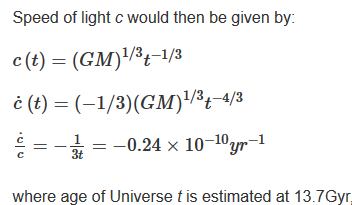
Величина изменения скорости света порядка 1,5 - 2 сантиметра в секунду за год.
А я больше доверяю Луйзе:

Покер
2017-02-01 17:50:49 (читать в оригинале)www.popmech.ru/technologies/323292-algor...u-cheloveka-v-poker/
Искусственный интеллект выиграл у четырех высококлассных игроков в техасский холдем — самую популярную разновидность покера. Игра состоялась в рамках турнира Brains Vs. Artificial Intelligence: Upping the Ant («Мозг против искусственного интеллекта: поднимая ставки»), который прошел в январе в Питтсбурге в штате Пенсильвания. За 20 дней турнира и 120 тысяч раздач люди проиграли компьютеру в общей сумме 1,7 миллиона долларов.
В прошлом году алгоритм Claudico от создателя Libratus уступил людям, проиграв примерно 700 тысяч долларов.
Любопытно, что покер — это вообще-то не главная задача Libratus. Его алгоритмы занимаются расчётом оптимального поведения в условиях, когда непонятно, что известно противнику.
Специалисты отмечают, что до сих пор ни один компьютер не выигрывал у человека в игру с таким большим количеством неизвестных. Покер принципиально отличается от шахмат, шашек или игры го, которые гораздо легче алгоритмизируются. В покере игрок не располагает практически информацией о картах противника, поэтому задача алгоритма — расчитывать вероятность всех возможных исходов и выбирать оптимальную стратегию.
Любопытно, что покер — это вообще-то не главная задача Libratus. Его алгоритмы занимаются расчётом оптимального поведения в условиях, когда непонятно, что известно противнику.
Специалисты отмечают, что до сих пор ни один компьютер не выигрывал у человека в игру с таким большим количеством неизвестных. Покер принципиально отличается от шахмат, шашек или игры го, которые гораздо легче алгоритмизируются. В покере игрок не располагает практически информацией о картах противника, поэтому задача алгоритма — расчитывать вероятность всех возможных исходов и выбирать оптимальную стратегию.
Вот и покер лег
Война в Донбассе (#6)
2017-02-01 17:47:40 (читать в оригинале)Хайдук wrote:
а как смог бы Обама помешать такой фигне даби не прослыть чмом?
Обама просто выражал озабоченность, а тут сразу какие-то требования
Обама говорил про "поддерживаемых Россией сепаратистов", "пророссийские силы", про "российских proxy", а тут сразу "российско-сепаратистские силы", "российско-сепаратистское наступление".
Чмо он, ваш Трамп, никакой деликатности




Категория «Музыканты»
Взлеты Топ 5
 | ||
|
+187 |
221 |
Yurenzo |
|
+178 |
226 |
FLL |
|
+170 |
187 |
rled |
|
+149 |
196 |
Elgrad.info - живой город - Соберемся вместе! |
|
+147 |
182 |
Vlad_Topalov |
Падения Топ 5
 | ||
|
-3 |
15 |
Nique |
|
-6 |
2 |
Евгений Гришковец |
|
-9 |
13 |
Мартышка_с_Алмазами |
|
-10 |
45 |
Детские советские композиторы |
|
-15 |
77 |
Indie Birdie Blog |

Популярные за сутки
Загрузка...

BlogRider.ru не имеет отношения к публикуемым в записях блогов материалам. Все записи
взяты из открытых общедоступных источников и являются собственностью их авторов.
взяты из открытых общедоступных источников и являются собственностью их авторов.